
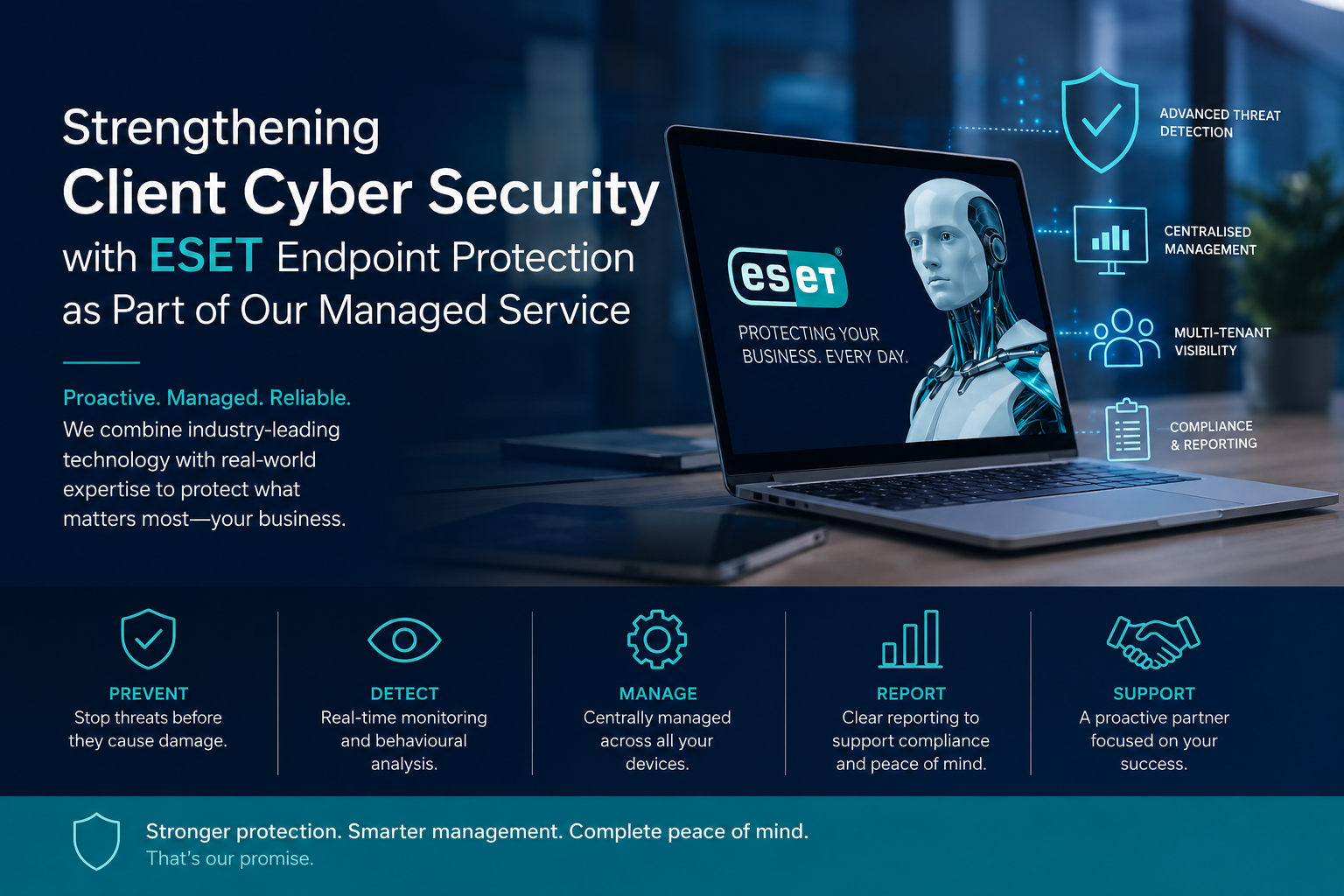
Cyber security is no longer a standalone product that businesses can simply install and forget. For organisations across the UK, it has become an ongoing operational requirement that must be actively managed, monitored, and continuously improved. As a managed service provider (MSP), our role is to ensure that protection is not only effective, but also practical, scalable, and aligned with real-world business operations.
A key part of our endpoint security strategy is our partnership and deployment of ESET, which forms a core layer of protection across the environments we manage.
Moving beyond traditional antivirus
Many businesses still assume that antivirus software alone is sufficient to protect them. In reality, modern threats such as ransomware, credential theft, and fileless malware require a far more sophisticated approach.
Our managed security model replaces reactive tools with layered endpoint protection, combining behavioural analysis, reputation-based detection, and real-time threat intelligence. This ensures that threats are not only identified, but disrupted before they can impact business operations.
ESET plays an important role in this approach by providing a lightweight yet powerful endpoint agent that delivers strong protection without degrading system performance or disrupting users.
Why we use ESET within our managed service stack
When selecting security technologies for our clients, we focus on three key principles: reliability, manageability, and efficiency.
ESET aligns well with these requirements.
From a reliability perspective, its detection engine combines multiple layers of protection, including behavioural detection and machine learning, to identify both known and emerging threats.
From a manageability perspective, the ESET PROTECT platform allows us to centrally manage all client endpoints through a multi-tenant console. This gives us full visibility across environments while enabling granular policy control where required.
From an efficiency perspective, ESET is known for its low system overhead. This matters in practice because it reduces performance impact on end-user devices and minimises support tickets related to endpoint slowdown or software conflicts.
Proactive protection, not reactive cleanup
One of the biggest challenges businesses face is assuming that cyber security is only about responding after an incident has occurred. In reality, the cost of recovery, downtime, reputational damage, and data loss can be significant.
Our approach is designed to prevent incidents before they escalate. ESET’s behavioural detection capabilities monitor processes in real time, identifying suspicious activity such as unusual encryption behaviour, privilege escalation attempts, or unauthorised access patterns.
This allows us to intervene early, often before ransomware or malware has a chance to execute its full payload.
Reducing noise while increasing visibility
Security tools are only effective if they can be operationally managed. Too many alerts create fatigue, which increases the risk of genuine threats being missed.
By using ESET within our managed service framework, we are able to focus on high-confidence alerts and meaningful security events, rather than overwhelming dashboards filled with low-value notifications.
This approach allows our engineering team to concentrate on real threats, while maintaining clear visibility across all client environments.
Supporting compliance and best practice
Many of our clients are working towards frameworks such as Cyber Essentials, Cyber Essentials Plus, and ISO 27001. Endpoint security is a foundational requirement for all of these standards.
The reporting and policy structure within ESET PROTECT enables us to produce clear security reporting that supports compliance audits and internal governance requirements. This includes visibility of patch status, threat detection history, and endpoint health across the organisation.
By aligning security tooling with compliance frameworks, we help clients not only improve their security posture, but also demonstrate it clearly to auditors and stakeholders.
Part of a wider managed security ecosystem
Endpoint protection is only one layer of a complete security strategy. Our managed service integrates endpoint security with backup solutions, email filtering, identity protection, and continuous monitoring.
ESET fits naturally into this ecosystem because it focuses on doing one thing exceptionally well: protecting endpoints. It integrates cleanly with broader security and monitoring tools without unnecessary complexity or overlap.
This modular approach allows us to build security stacks that are tailored to each client’s risk profile, rather than forcing a one-size-fits-all model.
Why this matters for your business
For most organisations, cyber security is not just an IT concern; it is a business continuity issue. A single ransomware incident or data breach can disrupt operations, damage client trust, and result in significant financial loss.
By combining our managed service expertise with proven technologies such as ESET, we provide a security foundation designed to reduce risk, improve resilience, and support business growth.
Our goal is not just to deploy tools, but to deliver outcomes: fewer incidents, faster detection, and greater confidence in your IT environment.
If you are reviewing your current cyber security approach, endpoint protection is one of the most important areas to evaluate. It is often the first line of defence, and in many cases, the difference between a contained alert and a major incident.
